Two Ancient Wisdom Traditions and What They Reveal About Cultural Values
Walk into nearly any English-speaking classroom, and you'll find a collection of Aesop's Fables. "The Tortoise and the Hare," "The Boy Who Cried Wolf," "The Ants and the Grasshopper"—these tales have dominated Western education for over two thousand years. Yet across the same timespan, and in largely overlapping geographical regions, an equally sophisticated and perhaps even more influential tradition was flourishing in India: the Panchatantra. While Aesop's Fables and the Panchatantra tales are often mentioned in the same breath as foundational wisdom literature, they represent fundamentally different approaches to teaching, different philosophical assumptions, and different cultural values.
For educators working with diverse student populations, understanding these differences is more than academic curiosity. It reveals how different cultures solve the same problems—teaching children about consequences, relationships, and survival—through radically different narrative strategies. It illuminates why the same lesson takes one form in Greece and another in India, and what we can learn from recognizing these patterns.
Origins and Historical Context
The World of Aesop
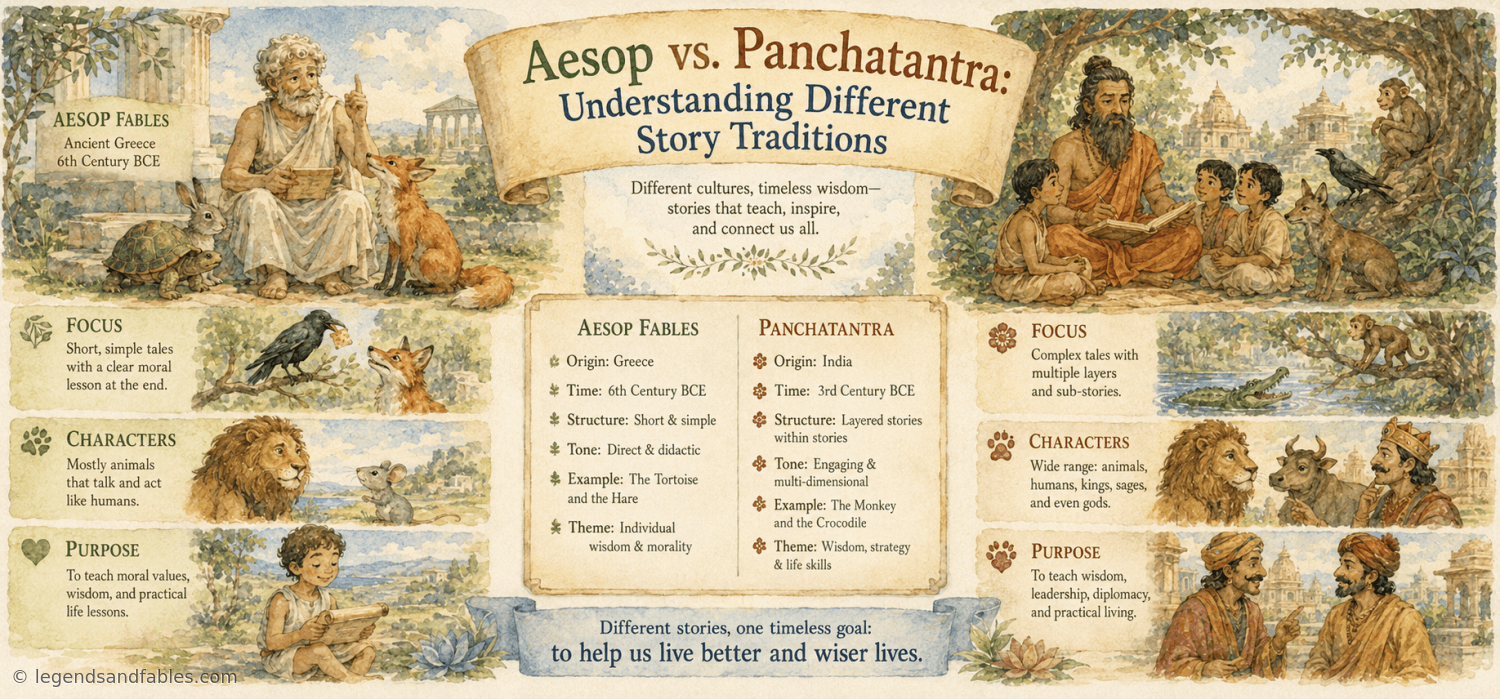
Aesop's Fables emerged in ancient Greece, likely around the 6th century BCE, though the exact historical Aesop remains elusive. What we know is that these fables circulated orally in Greece and were later collected and written down, eventually spreading throughout the Mediterranean world via Latin translations. By the time of the Roman Empire, Aesop had become synonymous with moral instruction.
The historical context matters: Aesop wrote for a society organized around city-states, individual achievement, and competitive excellence (arete). These were the values of ancient Greece, and his fables reflect them perfectly. The rabbits and tortoises race; the smartest crow wins the contest with the pitcher. The moral logic is fundamentally individualistic.
The World of the Panchatantra
The Panchatantra, whose name means "Five Treatises," originated in Sanskrit in ancient India, likely between the 3rd and 5th centuries CE—making it roughly contemporary with or slightly later than the written compilations of Aesop's Fables, though both traditions had longer oral histories. The Panchatantra was explicitly a political treatise, designed to teach princes about statecraft, strategy, and survival in complex court environments.
Unlike Aesop, the Panchatantra emerged from a worldview shaped by Hindu philosophy, concepts of dharma (duty), karma, and the intricate web of interdependence that characterizes South Asian thought. These tales were political survival guides for rulers who navigated complex alliances, treacherous ministers, and constant threats to power.
Structural and Narrative Differences
The Simple, Direct Moral
Aesop's Fables are economical narratives that move toward a single, explicit moral statement. A fable typically runs two to five paragraphs. The tortoise races the hare, the hare naps, the tortoise wins. Moral: "Slow and steady wins the race." The lesson is singular, memorable, and applicable across contexts.
This structure serves a pedagogical purpose: young children can remember these tales and extract clear behavioral lessons. Don't be proud. Don't lie repeatedly. Don't waste time on frivolities. The morals are often phrased as universal truisms that apply regardless of context.
The Layered, Nested Structure
The Panchatantra employs an entirely different narrative architecture. Tales are nested within tales, with stories interrupting stories, creating a complex, fractals-like narrative structure. A king and his advisor sit down to discuss a political problem. The advisor tells a story to illustrate principles relevant to that problem. Within that story, a character tells another story. Within that story, characters quote yet another story.
This structure reflects a fundamentally different philosophical assumption: that wisdom is contextual and contingent. The same principle applies differently depending on the specific circumstances, the relationships involved, the history between parties, and the political stakes. A simple universal rule won't work in a court where deception is constant and alliances shift.
For example, in the tale "The Monkey and the Crocodile," we encounter not a simple moral about not trusting strangers, but a sophisticated exploration of how we become vulnerable through friendship, how deception often hides behind appearances of intimacy, and how consequences ripple across relationships. A ruler listening to this tale understands multiple layers: trust is precious but dangerous; seemingly harmless relationships can mask hidden agendas; your emotional attachments can be weaponized against you.
Philosophical Differences: Universalism vs. Contextual Wisdom
Aesop's Universalist Approach
Aesop assumes that certain truths are universal and timeless. Wisdom consists of understanding these fixed principles and applying them consistently. Don't be vain—it will cause your downfall. Work hard—it leads to success. Keep your promises—breaking them harms you.
This reflects Greek philosophy's emphasis on universal forms, eternal truths, and principles that transcend individual circumstances. It's deeply influenced by Stoicism and the notion that a wise person understands cosmic order and aligns themselves with it.
Panchatantra's Contextual Approach
The Panchatantra, by contrast, embraces the notion that wisdom requires reading contexts, understanding relationships, and adapting principles to circumstances. As Sanskrit scholar Wendy Doniger notes, the Panchatantra teaches "the art of knowing how things actually work" rather than abstract ideals.
This reflects Hindu philosophy's emphasis on dharma—which doesn't mean a single fixed duty but rather "the right action appropriate to your role, status, and the specific moment in time." A king's dharma differs from a subject's dharma. The right action when you have power differs from the right action when you're vulnerable. This isn't moral relativism; it's sophisticated contextual ethics.
Animal Characters and Their Functions
Aesop's Animals as Universal Types
In Aesop, animals function as transparent representations of human types and behaviors. The fox represents cunning, the ant represents diligence, the grasshopper represents frivolity. When a fox appears in an Aesop fable, readers immediately understand: this character will use intelligence, probably deceptively.
This is pedagogically clear but philosophically limiting. The same character always represents the same trait. There's no complexity, no growth, no nuance.
Panchatantra's Animals as Complex Agents
The Panchatantra employs the same animals—jackals, crows, mice, tigers—but they function as complex, evolving characters whose behavior changes based on context and strategy. A jackal who is clever and successful in one situation must adapt to survive in another. Animals have histories, alliances, and shifting fortunes.
In "The Crow, the Serpent, and the Hunter," the crow isn't simply a representation of a single trait. The crow is a character with a specific history, a specific relationship with the serpent, specific vulnerabilities, and specific opportunities for alliance. The wisdom isn't "crows are clever" but rather "understand the full context of relationships before acting."
Moral Ambiguity and Ethical Complexity
Aesop's Clear Good and Bad
Aesop's Fables typically present clear moral axes: the industrious ant is good, the idle grasshopper is bad; the honest boy is good, the boy who lies is bad. Characters don't grow or transform morally. They exhibit their essential nature, and consequences follow.
This clarity is valuable for children learning basic behavioral principles. It's less useful for complex situations where multiple goods conflict or where someone needs to make difficult choices.
Panchatantra's Moral Complexity
The Panchatantra frequently presents scenarios where characters act immorally or deceptively and succeed, or where following conventional morality leads to disaster. This isn't cynicism; it's realism about how power actually works.
In "The Jackal and the Drum," a jackal finds a drum on a battlefield. The drum, when struck, makes a terrifying sound. The jackal imagines killing animals with it—until a rabbit investigates and discovers the drum is empty. The tale doesn't offer a simple moral but rather teaches a lesson about investigating reality before reacting to appearances—a lesson directly relevant to ruling.
More provocatively, several Panchatantra tales teach that deception, even by a protagonist, can be justified and necessary for survival. A weak animal might deceive a stronger one to survive. A minister might deceive a king to serve the kingdom's greater good. These aren't presented as moral failures but as contextual necessities understood through the lens of dharma.
This complexity prepares readers (particularly young rulers) for the actual moral ambiguities of leadership far better than Aesop's clearer divisions between good and bad characters.
Different Purposes: Entertainment vs. Statecraft
Aesop as Educational Literature
Aesop's Fables were created primarily to teach children about character and behavior. They're short enough for young minds to follow, memorable enough to retain, and universal enough to apply across situations. A parent or teacher could tell an Aesop fable, extract a clear lesson, and have done their work.
This doesn't diminish their value—clarity and memorability are powerful pedagogical tools. But it reflects Aesop's primary purpose: transmitting behavioral wisdom to the young.
Panchatantra as Political Science
The Panchatantra was explicitly written for a different audience: princes and future rulers who needed to understand the complexities of statecraft, diplomacy, and survival in hierarchical, often hostile court environments. The frame story makes this explicit—a wise minister tells these tales to teach a king's sons about governance.
This purpose explains the Panchatantra's structural complexity, moral ambiguity, and emphasis on understanding others' motives and manipulating situations. A prince reading about the monkey and crocodile isn't just learning about trust; he's learning about how emotional bonds can be weaponized, how flattery and intimacy hide danger, and how a wise leader must maintain emotional distance even from those he cares for.
The Panchatantra is, in some sense, an ancient treatise on political realism—what we might now call statecraft or power dynamics—disguised as entertaining animal tales.
Influence and Global Spread
Aesop's Western Dominance
Aesop's Fables became the dominant wisdom literature of the Western world, translated into Latin, then into every European language. They shaped European moral education for over two thousand years. By the Medieval period, they were ubiquitous in monasteries and schools. By the Enlightenment, every educated person knew them.
This dominance wasn't accidental. Aesop's clarity and universalism fit well with Christian moral teaching, with Enlightenment rationalism, and with the needs of mass education. The fables were easy to translate, easy to illustrate, easy to teach.
Panchatantra's Eastward and Later Westward Journey
The Panchatantra followed a different trajectory. It traveled eastward along trade routes, reaching Southeast Asia, China, and Japan by the 5th and 6th centuries CE, where it profoundly influenced those regions' wisdom traditions. It also traveled westward, reaching Persia and the Arab world, where it was reworked as the Kalila wa-Dimna.
Only much later—during the colonial period—did Western scholars become aware of the Panchatantra's existence and significance. Even then, it remained less integrated into Western education than Aesop. This reflects not quality but rather the accidents of colonialism and which texts colonizers chose to emphasize.
Today, the Panchatantra is revered across Asia, the Middle East, and among scholars of wisdom literature worldwide, though it remains less universally known in English-speaking schools than Aesop—a gap that reflects historical power dynamics more than literary merit.
Comparing Six Specific Tales
The Tortoise and the Hare vs. The Frogs and the King Crane
Aesop's "The Tortoise and the Hare" is about individual effort and consistency. The hare is overconfident; the tortoise is steady. They race; the tortoise wins. The moral: "Slow and steady wins the race."
The Panchatantra's "The Frogs and the King Crane" (or similar tales about a weak group and a seemingly benevolent powerful figure) tells a different story. Frogs live happily until a crane arrives, promising to be their king. Initially, the crane appears benevolent, but gradually begins eating frogs under the guise of royal judgment. The frogs survive only by recognizing the crane's true nature and eliminating him.
The contrast is striking: Aesop teaches self-improvement and consistency. The Panchatantra teaches recognizing hidden threats and taking necessary action to survive, even if that action violates conventional respect for authority.
The Ant and the Grasshopper vs. The Weaver Birds and the Elephant
Aesop's "The Ant and the Grasshopper" pits industriousness against frivolity. The ant works; the grasshopper plays. Winter comes; the ant survives; the grasshopper perishes. Moral: "Idleness brings want."
A Panchatantra tale with similar surface structure might involve animals with different capacities forming alliances. A small, industrious creature and a powerful but lazy creature must cooperate. The tale explores how different natures must be understood and accommodated, how strength and weakness are distributed across the group, and how survival depends on mutual understanding rather than simply working harder than others.
The Aesop tale emphasizes individual responsibility; the Panchatantra tale emphasizes relationship dynamics and collective strategy.
The Lion and the Mouse vs. The Lion and the Jackal
Aesop's "The Lion and the Mouse" teaches about gratitude and the value of small kindnesses. A mighty lion frees a small mouse from a trap. Later, the mouse saves the lion from hunters. Moral: "No act of kindness is ever wasted."
A similar Panchatantra tale might feature a lion and a jackal in a more complex dynamic: the jackal uses flattery and false friendship to gain the lion's trust and access to his kills. The tale teaches about recognizing deception hidden in apparent friendship, about the difference between true alliance and strategic manipulation.
Aesop celebrates kindness; the Panchatantra warns about the dangers of misplaced trust.
What Educators Should Know: Teaching Both Traditions
Why Both Matter
Neither tradition is superior; they're different tools for different purposes. Aesop's Fables remain excellent for teaching children about basic character virtues—kindness, hard work, honesty. Their clarity and brevity make them accessible to young minds and memory.
The Panchatantra is essential for older students, particularly those preparing for leadership roles or studying literature, history, and ethics. It teaches how the world actually works, not how we wish it worked. It develops sophisticated ethical reasoning, contextual thinking, and the ability to navigate complex social dynamics.
Introducing Both in Classrooms
For elementary ESL students, Aesop's Fables work well because of their simplicity and clear moral lessons. The stories are short, the vocabulary is controllable, and students can easily extract and discuss the lesson.
For intermediate and advanced ESL students, introduce Panchatantra tales. The nested narrative structure provides a more complex linguistic and literary challenge. Students must follow multiple storylines, understand how frame narratives work, and grapple with more sophisticated moral ambiguities.
For literature and history classes, explicitly compare the two traditions. Have students analyze what different cultures value based on the stories they tell. Why did Aesop's Fables emphasize individual virtue while Panchatantra emphasizes contextual strategy? What does this reveal about ancient Greek vs. ancient Indian philosophy?
Discussion Questions for Comparative Analysis
- If the same character appears in both traditions (a lion, a crow), how is their nature portrayed differently?
- Why might Aesop's simpler moral structure have been more useful for mass education in the West?
- How do different ethical frameworks (universalist vs. contextual) appear in these stories?
- Which tradition better prepares you to navigate real-world complexity? Why?
- How might your own cultural background influence which type of story feels more "true" to you?
The Philosophical Divide: East Meets West in Story
Understanding the difference between Aesop and the Panchatantra is, in many ways, understanding the difference between Western and Eastern philosophical traditions.
Western philosophy, rooted in Greek rationalism, seeks universal principles. What is Justice? What is Virtue? What is Truth? These questions assume that answers exist independent of context. Aesop's Fables reflect this impulse perfectly: there are universal moral truths, and wisdom consists of understanding and following them.
Eastern philosophy, particularly as developed in India, embraces contextual truth and adaptive wisdom. Dharma isn't a fixed set of rules but a principle to be applied differently depending on who you are, what your role is, and what moment in time you're living through. The Panchatantra reflects this impulse: wisdom comes from understanding context, recognizing patterns, and adapting principles to specific circumstances.
Neither approach is objectively "better." They're different solutions to the problem of teaching wisdom and virtue. In a globalized world where students and educators work across cultures, understanding both is increasingly essential.
Conclusion: Stories Reveal Values
Folktales reveal what cultures value, what they fear, and how they understand human nature. Aesop tells us that ancient Greek civilization valued individual achievement, virtue, and the idea that consistent effort produces success. The Panchatantra tells us that ancient Indian civilization valued political wisdom, contextual understanding, and the complex web of relationships that determines survival.
For educators working with diverse student populations, this matters profoundly. When you teach only Aesop's Fables, you're implicitly saying that Western moral logic is universal. When you teach both Aesop and the Panchatantra, you're saying that wisdom takes multiple forms and that understanding different cultural approaches to ethics makes you more truly educated.
The question for contemporary educators isn't whether to teach Aesop or the Panchatantra. It's how to teach both in ways that illuminate the assumptions underlying each, that celebrate the sophistication of different wisdom traditions, and that prepare students to navigate a world where they'll encounter multiple ethical frameworks and must develop the flexibility to understand and respect them.
In doing so, we offer students something far more valuable than a list of moral rules: we offer them multiple ways of seeing, thinking, and understanding the complex human world they're inheriting.