
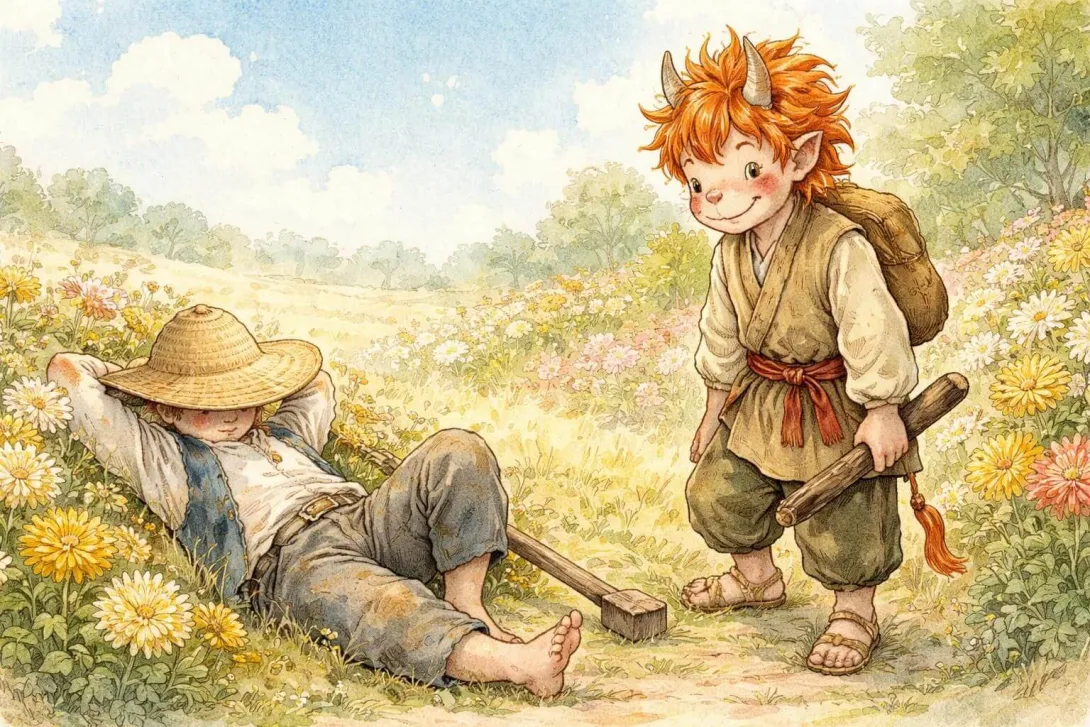
In a small village nestled between two great mountains, there lived a farmer named Seol-moon. He spent most of his days lounging in his hammock, watching the clouds drift lazily by.
Seol-moon's wife, Jang-hee, worked tirelessly from dawn till dusk to tend to their farm. She would wake up before the sun rose, feed the animals, and water the crops while Seol-moon slept soundly. Despite her efforts, their farm was struggling. The crops were withering away, and the once-quaint garden was now overgrown with weeds.
Seol-moon spent his days reading about magic and mythical creatures from old books he found in the village market. One day, as he flipped through the pages of a dusty tome, he stumbled upon a story about the Dokkaebi – mischievous spirits that roamed the countryside, playing tricks on unsuspecting villagers. Intrigued, Seol-moon decided to summon one.
Seol-moon spent hours chanting and performing rituals to call forth the Dokkaebi. Finally, as night began to fall, a tiny Dokkaebi with pointed ears and sharp teeth appeared before him.
"Ah, I've summoned you!" exclaimed Seol-moon, still half-asleep. "Grant me wealth and prosperity! Make my crops grow strong and healthy!"
The Dokkaebi snickered and rubbed its belly. "Lazy farmer, why do you seek riches when you're too busy lounging in your hammock? Your wife toils day and night while you waste the daylight reading foolish tales."
Seol-moon's eyes widened as he stared at his own laziness reflected in the Dokkaebi's words.
The Dokkaebi vanished with a wink, leaving Seol-moon feeling ashamed. Jang-hee entered the room, tired from her day's work, and found Seol-moon wide awake and pensive.
"What's wrong?" she asked gently.
Seol-moon recounted his encounter with the Dokkaebi, and for the first time in months, he saw the truth in his own actions. He vowed to help Jang-hee with the farmwork, working alongside her under the scorching sun.
As they labored together, the crops began to grow strong once more. The weeds were eradicated, and their garden flourished. Seol-moon learned that true wealth wasn't in gold or silver but in the love and hard work he shared with his wife.
From then on, Seol-moon became a changed man – no longer lazy, no longer idle. He tended to their farm with dedication, side by side with Jang-hee, and together they built a life filled with laughter and purpose.
💡 Life's Lesson from this story
Hard work and responsibility are the keys to a happy life.
🗺️ Cultural Context
📚 Word of the Story
- Mischief — playful troublemaking
- Dokkaebi — a mischievous spirit from Korean folklore
- Harmonious — having a peaceful and happy atmosphere
💬 Let's Talk About It
What are some consequences that might have happened if the lazy farmer had not been honest with the dokkaebi?
How do you think the dokkaebi's actions in the story reflect what we can learn about hard work and responsibility?
Do you think the dokkaebi was fair to the lazy farmer, or did he go too far in punishing him for his laziness?