In the age of the Norse gods, when the great halls of Asgard rang with feasting and thunder, Thor the Thunderer woke one morning to discover the worst thing imaginable: his mighty hammer, Mjolnir, was gone.
Without Mjolnir, Thor could not protect Asgard from giants or monsters. The gods searched every corner of the nine worlds. At last, the cunning god Loki discovered the truth — Thrym, king of the Frost Giants, had stolen it and buried it eight miles underground.
"I will return it," said Thrym, his voice like grinding ice, "for only one price: the goddess Freya as my bride."
Freya was so furious when she heard this that her rage shook the floor of Asgard. "I will never be a giant's prize!" she declared.
The gods sat in dismayed silence. Then Loki smiled his dangerous smile. "I have an idea. But Thor is not going to like it."
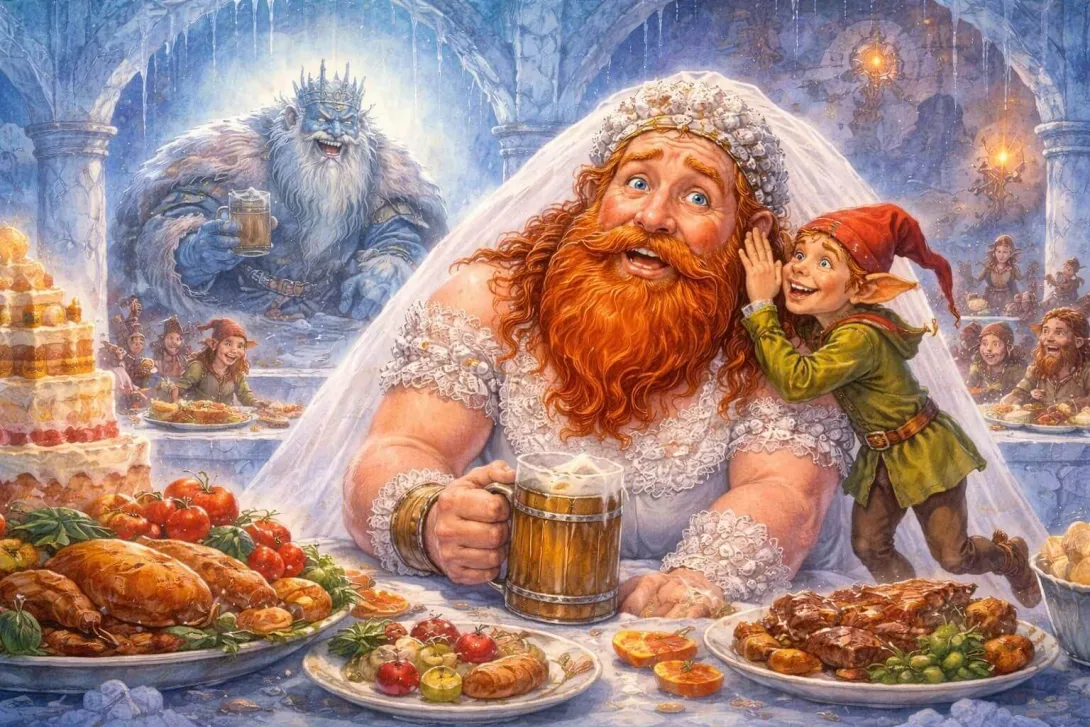
The plan was this: Thor himself would dress as the bride. With a veil over his face and Loki disguised as his handmaiden, they would travel to the land of the Frost Giants.
Thor's face turned as red as his beard. "I will not wear a dress," he growled.
"Would you rather never see Mjolnir again?" said Loki simply.
The wedding feast in Thrym's hall was magnificent and strange. Thor ate an entire ox, eight salmon, and all the cakes meant for the women, washing it down with three barrels of mead. Thrym watched, puzzled. "I have never seen a bride eat so much," he said.
"She was too excited to eat for eight days before the wedding," said Loki smoothly.
Thrym leaned close to lift the veil — and saw two eyes blazing like lightning. "Why are your eyes so fierce, my bride?"
"She was too eager to sleep for eight nights!" said Loki.
Finally, as custom demanded, Thrym brought out Mjolnir to bless the bride. The moment the hammer touched Thor's hands, he threw back his veil, roared like a thunderstorm, and brought Mjolnir down.
The Frost Giants learned that day that you should never, ever steal from a thunder god — no matter how well you hide it.
💡 Life's Lesson from this story
Sometimes the bravest thing is to set aside your pride and do what needs to be done - no matter how silly it feels.
🗺️ Cultural Context
📚 Word of the Story
- Mjolnir — Thor's famous hammer in Norse mythology, said to be so powerful it could level mountains
- Mead — a sweet drink made from honey, popular in ancient Scandinavia
- Cunning — clever in a crafty, sometimes tricky way
💬 Let's Talk About It
Why did Thor agree to the plan even though he hated it?
Loki is often a troublemaker in Norse myths — do you think he was truly helping here or enjoying Thor's embarrassment?
Have you ever had to do something embarrassing to help a friend or fix a problem?