In a small village nestled in the heart of the Andes, there lived a young warrior named Kanaq. He was known for his bravery and kindness, and the villagers looked up to him with admiration. Kanaq's best friend was a wise old shaman named Tikaq, who possessed knowledge of the ancient traditions and secrets of their people.
Kanaq and Tikaq spent many days exploring the dense rainforest that surrounded their village, searching for hidden treasures and learning about the mystical powers of the plants and animals. One day, as they were trekking through a particularly dense thicket, Tikaq stumbled upon an ancient map etched on a stone pedestal. The map depicted a shimmering city deep within the jungle, filled with gold and precious jewels.
Excited by their discovery, Kanaq and Tikaq set out to find the lost city of gold. They traversed rivers, climbed mountains, and braved treacherous terrain, guided by the map's cryptic symbols. After many moons, they finally reached a clearing and beheld the majestic sight of El Dorado – a city so resplendent that it seemed as though the sun itself had descended to earth.
However, upon entering the city, Kanaq and Tikaq realized that its beauty was not just physical, but also spiritual. The buildings, crafted from a glittering white stone, were infused with an otherworldly energy. But as they explored further, they encountered an enigmatic guardian named Akua, who revealed to them that El Dorado's true treasure lay not in gold or jewels, but in the harmony and balance of nature.
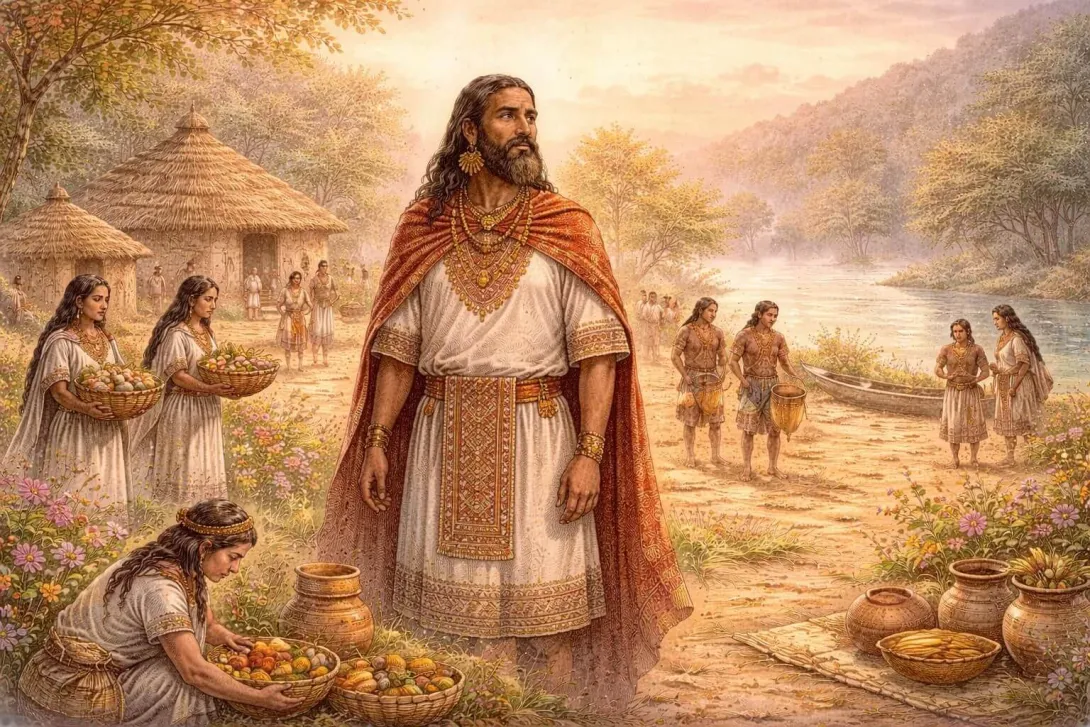
Akua explained that centuries ago, a wise leader had created this city as a sanctuary for the heart of the jungle. The inhabitants lived in perfect sync with their environment, honoring the cycles of life and death. But over time, greed and ambition had consumed them, disrupting the delicate equilibrium and causing the city to disappear into the mists.
Kanaq and Tikaq understood that El Dorado's true treasure was not something to be exploited or coveted, but rather a lesson in reverence for the natural world. They realized that they had been tasked with uncovering more than just gold – they had discovered the importance of living in harmony with nature.
From that day forward, Kanaq and Tikaq returned to their village as guardians of their own people's traditions and balance with the environment. They shared the story of El Dorado's lesson, ensuring that future generations would remember the wisdom of respecting and preserving the delicate harmony of our planet. And as they looked up at the starry sky, Kanaq smiled knowing that a piece of El Dorado remained within him, guiding his path towards a brighter tomorrow.
As the sun set over the Andes, Tikaq gazed at Kanaq with a wise and knowing look in his eyes, whispering, "The treasure of El Dorado is not something to be found; it's something to be remembered."
💡 Life's Lesson from this story
"The treasures of El Dorado lie within oneself, not in gold."
🗺️ Cultural Context
📚 Word of the Story
- Treacherous — having obstacles or dangers that make it hard to get through
- Exhilarating — feeling very excited and happy because of a thrilling experience
- Ransacked — when people quickly take things from somewhere, often by force
💬 Let's Talk About It
What do you think it means to have wisdom like the Muisca people, who were said to possess a deep understanding of the world and its secrets?
How would you feel if you were given the opportunity to participate in a ritual like the Festival of the Sun, and what might be some things you would give thanks for during such an occasion?
What do you think it means to show respect to a place or a people, like the Muisca's reverence for their gold lake, and how can we apply this idea in our own lives?