In a small village nestled between two great rivers, there lived five blind men named Rashid, Jafar, Amir, Khaled, and Abbas. They had been born and raised in this village, surrounded by the lush green forests of Persia. Each man was skilled in his own way: Rashid could play the most beautiful melodies on his flute; Jafar could weave the finest carpets with intricate patterns; Amir could cook the tastiest kebabs with spices from far-off lands; Khaled could tell the most thrilling stories about the mythical creatures that roamed the desert; and Abbas, well, Abbas was an expert at sensing the world around him through his sensitive fingers.
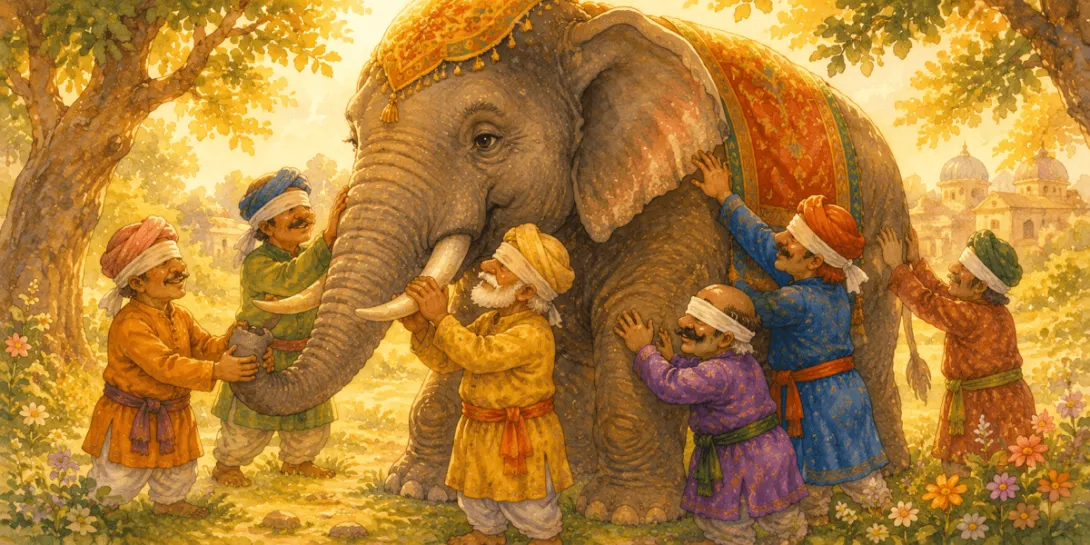
One day, a majestic elephant wandered into their village. The villagers were amazed by its size and strength, but the five blind men were particularly intrigued. They had never seen or heard of such an animal before! Rashid reached out to touch the elephant's trunk, feeling its smooth texture and imagining it as a giant snake. "This must be a mighty serpent!" he exclaimed.
Jafar stroked the elephant's side, marveling at its hard, scaly skin. "No, no," he said confidently, "this is a great tortoise, wise and old."
Amir tentatively touched the elephant's tusk, declaring it to be a giant horn, strong enough to defend against any enemy.
Khaled ran his hands over the elephant's ears, which he thought sounded like two enormous drums. "This must be some sort of magical instrument!" he declared.
Abbas, meanwhile, listened carefully as the elephant breathed in and out. He sensed its massive body moving beneath him and felt a strange vibration in the air. "I think," Abbas said quietly, "that this is something much bigger than any animal we've ever known."
The five men began to argue among themselves, each convinced that his own understanding was correct. Rashid insisted it was a serpent; Jafar claimed it was a tortoise; Amir swore by the horn; Khaled thought it was a magical instrument; and Abbas whispered that it was something entirely new.
Just then, the elephant let out a mighty trumpet sound, startling the men. The ground shook beneath their feet as the elephant moved its massive body.
The blind men froze, awestruck by the elephant's power. Slowly, they realized that each of them had caught just one aspect of the truth. Rashid saw the trunk; Jafar felt the side; Amir touched the tusk; Khaled heard the ears; and Abbas sensed the breath. Together, their fragments formed a complete picture.
As they stood there in silence, the elephant gently stepped closer to them. In that moment, the five blind men understood that the truth is often incomplete when seen through only one perspective. The world is full of wonders that can only be fully appreciated by combining our unique experiences and insights.
From that day forward, Rashid, Jafar, Amir, Khaled, and Abbas looked at their village with fresh eyes, grateful for the rich tapestry of lives they wove together.
💡 Life's Lesson from this story
"Truth is a tapestry, and each thread has its own story to tell."
🗺️ Cultural Context
📚 Word of the Story
- Tentative — trying or touching something gently
- Huge — extremely large or big
- Enthusiastic — showing a lot of excitement and interest
💬 Let's Talk About It
How can having different perspectives on the same thing help us learn more about the world?
What can we learn from the blind men who couldn't agree on what the elephant was like, and how can this teach us to be humble in our own understanding of things?
Why is it often better to take a step back and wait for all the facts before jumping to conclusions, rather than rushing to make decisions or judgments?