
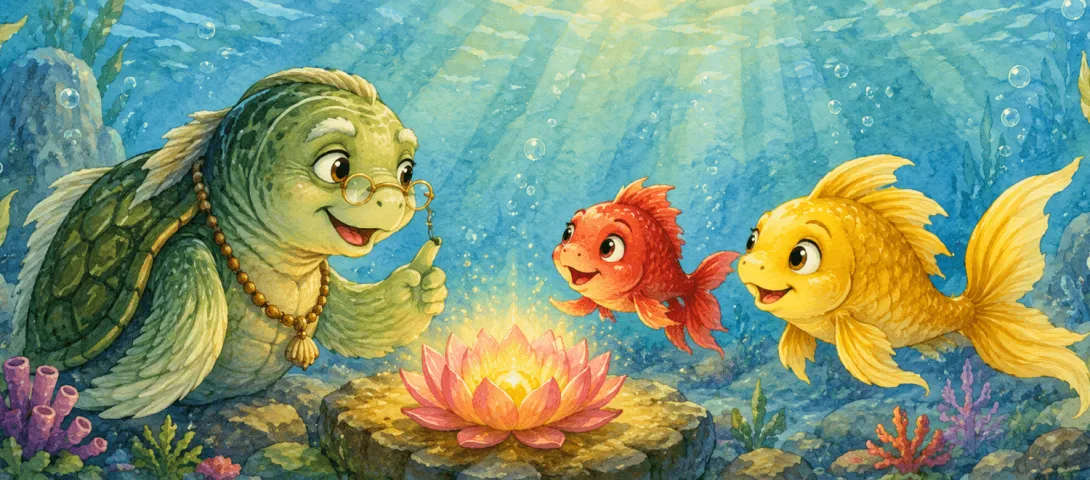
In a small village nestled between two great rivers in the land of ancient India, there lived three fish named Ranga, Kavi, and Laxmi. They resided in a crystal-clear pond surrounded by lush greenery and vibrant flowers. Ranga was a bright red fish with shimmering scales, Kavi was a wise silver fish with piercing eyes, and Laxmi was a gentle golden fish with soft fins.
The three friends loved to spend their days swimming together, chasing after schools of tiny minnows, and playing hide-and-seek among the water lilies. They would often gather on the riverbank to listen to Kavi's tales of adventure and bravery. Ranga loved to boast about his own exploits, claiming he was the fastest swimmer in the pond. Laxmi preferred to keep a low profile, content with watching the world go by from her favorite spot beneath a shady willow tree.
One day, as they were swimming near the riverbank, they spotted a magnificent golden statue of the deity, Ganga Maiya, placed on a pedestal. The villagers had brought it to the pond for blessings and protection. Ranga, ever the show-off, decided that he could move the statue with his incredible strength. Kavi cautioned him against trying, warning that the task was far beyond their capabilities.
Laxmi, being the gentle soul she was, tried to reason with Ranga, pointing out that even if they managed to move it, they would be disturbing the balance of nature and upsetting the villagers who had placed the statue there for good reasons. But Ranga laughed at her concerns, calling her timid and weak.
As the three friends argued, a wise old tortoise named Ganga poked his head out from beneath a nearby rock. He listened attentively to their discussion and offered some words of wisdom: "It's not about being strong or clever; it's about understanding the world around you and respecting its harmony."
The three fish looked at each other uncertainly, realizing that they had been foolish to ignore Ganga's warning. Just then, a strong gust of wind swept by, knocking over the pedestal and sending the statue tumbling into the water. To everyone's surprise, it began to sink rapidly.
With their combined efforts, Ranga, Kavi, and Laxmi managed to save the statue from sinking further down into the depths of the pond. As they lifted it back onto its pedestal, Ganga Maiya smiled upon them, her golden form shining brightly once more.
From that day forward, Ranga learned to appreciate the value of teamwork and humility, Kavi gained confidence in his wisdom, and Laxmi continued to be a voice of gentle reason amidst her friends' tumult. As they swam away from the riverbank, Ganga's words echoed in their minds: "Respect the balance of nature, and you shall find harmony within yourself.
💡 Life's Lesson from this story
Greed can lead to loss of everything one holds dear.
🗺️ Cultural Context
📚 Word of the Story
- Fathom — To measure or understand how deep something is
- Rigorous — Doing things carefully and thoroughly to get good results
- Miserable — Feeling very unhappy or sad
💬 Let's Talk About It
What did the fish learn from the wise old tree in the story and how can we apply its wisdom to our own lives?
How did the clever rabbit use its problem-solving skills to help the fish, and what can we learn about being resourceful like the rabbit?
Why was it important for the brave fish to face its fears and take a stand against the bully, and what can we do when faced with our own scary situations?