
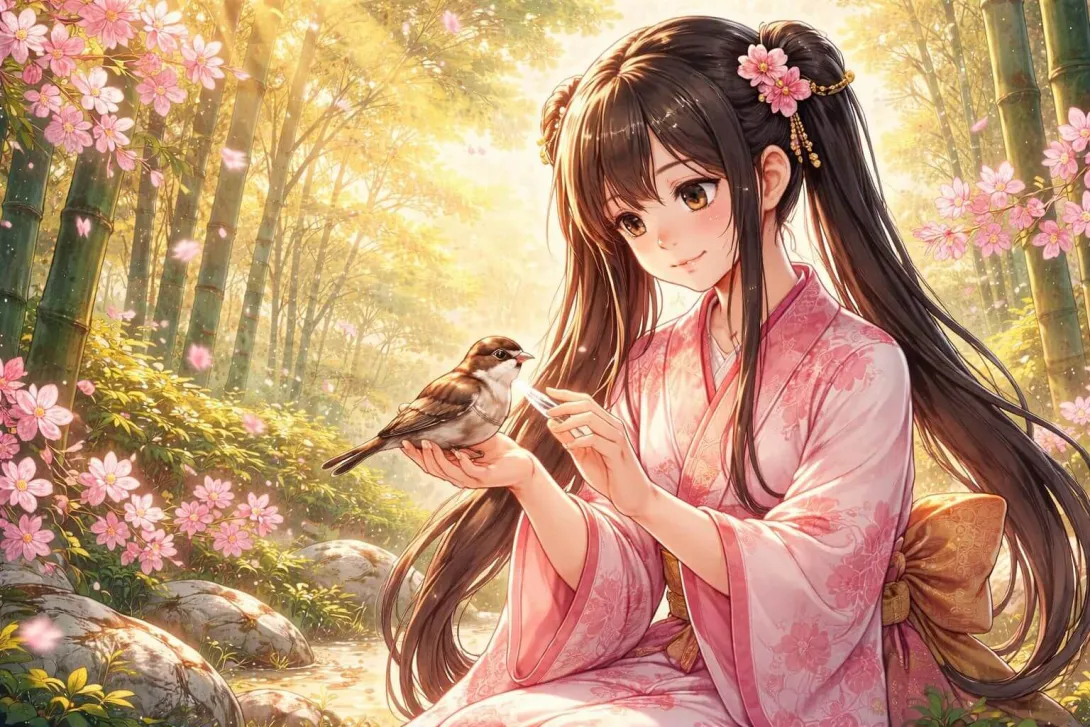
In a small village nestled between two great mountains in feudal Japan, there lived a kind and gentle princess named Emiko. She was known throughout the land for her beautiful long black hair, which cascaded down her back like a waterfall of night sky silk. Her smile could light up even the darkest of rooms, and her laughter was as sweet as the scent of cherry blossoms.
Emiko loved nothing more than to spend her days exploring the forest that surrounded the village. She would wander through the bamboo groves, listening to the soft rustling of the stalks in the breeze, and watching the sunlight filter through the delicate leaves. The villagers would often remark on how at one with nature Emiko seemed to be, as if she were a part of the forest itself.
One day, while wandering deeper into the woods than she had ever been before, Emiko stumbled upon an ancient bamboo flute lying abandoned on the forest floor. Intrigued, she picked it up and began to blow through its delicate mouthpiece. To her surprise, the most beautiful, haunting melody filled the air, drawing out a family of deer from their hiding places in the underbrush.
Entranced by the music, Emiko's feet moved as if on their own, leading her deeper into the forest. The deer followed closely behind, their large eyes shining with a deep longing. As they walked, the trees seemed to grow taller and closer together, forming an enchanted tunnel that wrapped itself around the little procession.
But their journey was not without danger. A great storm brewed in the mountains above, its dark clouds churning with electric power. The wind began to howl through the forest, threatening to destroy the fragile balance of nature. Emiko's flute sang out against the tempest, but even its sweet voice seemed no match for the fury of the storm.
Just when it seemed as though all was lost, Emiko remembered a lesson her wise old grandmother had once taught her: that in times of great turmoil, one must find stillness within themselves. Closing her eyes, she focused on the gentle rustling of the bamboo stalks and let go of all fear. The flute sang out again, this time with an even more soothing melody that seemed to match the rhythm of Emiko's own heartbeat.
Slowly but surely, the storm began to subside, its darkness receding like a tide going out. The deer rejoiced at their newfound safety, and the trees stood tall once more, their leaves rustling softly in the gentle breeze. From that day on, Emiko was known not only for her beauty and kindness, but also for her wisdom and connection to the natural world.
As she returned to her village, the wind whispering through the bamboo groves carried a message that would be remembered for generations to come: that even in the most turbulent of times, stillness and harmony can restore balance to the world.
💡 Life's Lesson from this story
"True happiness comes from helping others, not personal gain."
🗺️ Cultural Context
📚 Word of the Story
- Enthrall — to completely capture someone's attention
- Rigorous — very strict or demanding in a way that is intended to improve something
- Festive — having or showing a joyful and lively atmosphere
💬 Let's Talk About It
What did the Bamboo Princess learn from her experiences in the forest, and how did it help her grow as a person?
How does the story show that being humble and willing to listen can be more important than having great knowledge or power?
Can you think of a time when you had to choose between doing something for yourself or standing by someone else who needed your help?