
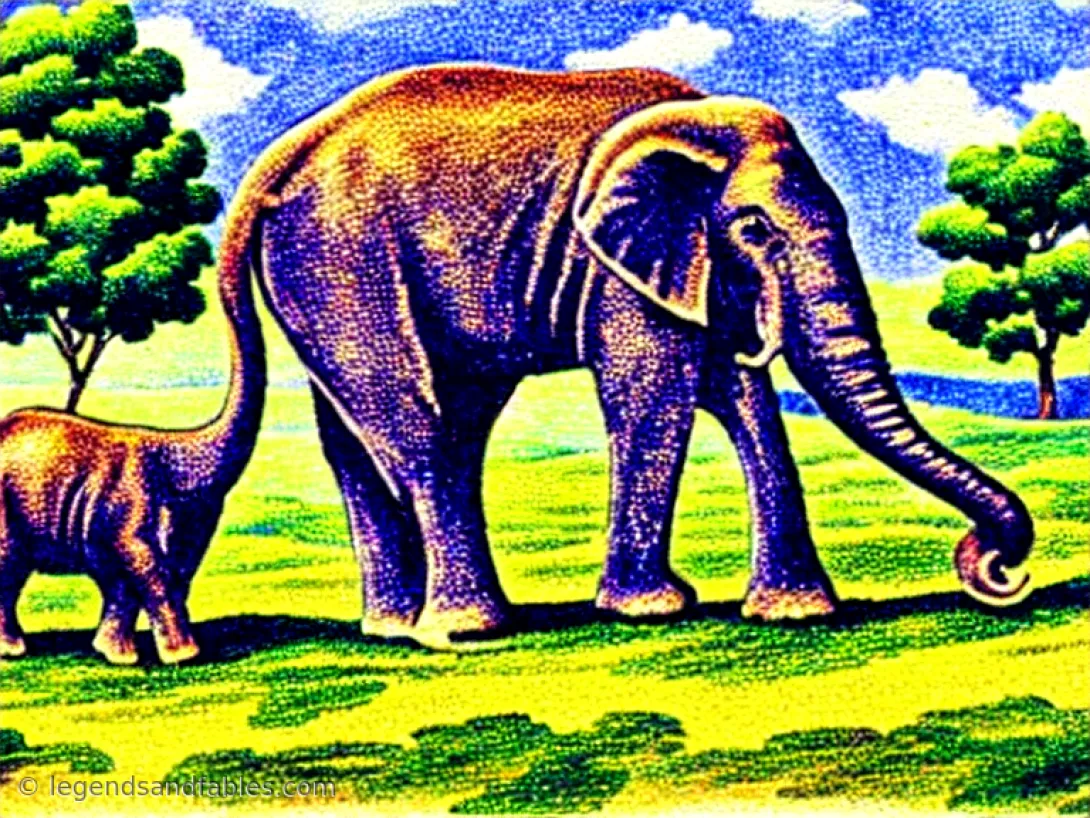
In the time of our ancestors, in a land filled with vast savannas and mighty rivers, there lived a young elephant named Bwana. He was kind and gentle, loved by all who knew him. Bwana's family and friends would often visit the wise old tortoise, Kofi, to seek his counsel on matters of great importance.
Bwana and Kofi were sitting under the shade of an acacia tree one day when the elephant asked the tortoise, "Kofi, why do I have such a long nose? It gets in the way when I'm eating and drinking." Kofi looked at Bwana with his wise eyes and said, "My young friend, your trunk is not just for show. It has a special purpose."
Bwana's curiosity got the best of him, so he asked Kofi to explain what he meant. Kofi took a deep breath and began to tell the story of how the Great Creator, Mawu, had given Bwana his long nose as a gift. Long ago, when the world was still young, Mawu was creating all living things. She made the birds with their beautiful songs, the lions with their mighty roars, and the elephants with their strong trunks.
But Mawu noticed that one of her creations, a group of humans, were struggling to survive in the harsh African savannas. They had no way to reach the juicy fruits on tall trees or fetch water from far-off rivers. Mawu decided to give them a special gift – the long nose of Bwana's ancestors. And so, the first elephant was born with a long trunk that could stretch and grab for food and drink.
Bwana listened carefully to Kofi's story and felt a sense of pride knowing that his long trunk was a gift from Mawu. From that day on, he used his trunk with gratitude, reaching for the ripest fruits and the freshest water. And as he did, he remembered the wise words of Kofi: "A gift is not just something to use, but also a reminder of where we come from."
Bwana continued to live in harmony with nature, using his long nose wisely. The other animals respected him for his kind heart and resourcefulness. As the years passed, Bwana's legend grew, and children would gather around Kofi's feet to hear the tale of how Mawu gave the elephant its special gift. And whenever they looked at an elephant with a long trunk, they remembered the story of Bwana and the Great Creator's kindness.
Years went by, and Bwana grew old and wise. He would often sit under the same acacia tree where he had first learned about his special gift. Kofi would join him there, and together they would watch the young ones playing in the shade. The tortoise would smile and say, "Bwana, your long nose is a reminder that even the smallest thing can be used for great good."
💡 Life's Lesson from this story
"Humility is strength; pride leads to downfall, every time."
🗺️ Cultural Context
📚 Word of the Story
- tendril — a long thin stem that grows from a plant to climb up something
- hibernation — a long sleep that some animals take during winter
- amphibian — an animal that lives in water and on land but comes back to water to lay eggs
💬 Let's Talk About It
Do you think elephants have long trunks to help them reach high branches and eat delicious fruits, or is there something more special about their trunk?
Why do you think elephants have kept their long trunks for so many years, even though they can be a bit tricky to use in certain situations?
How do you think we can show respect to animals like elephants with unique features, and what can we learn from the way they take care of themselves?