
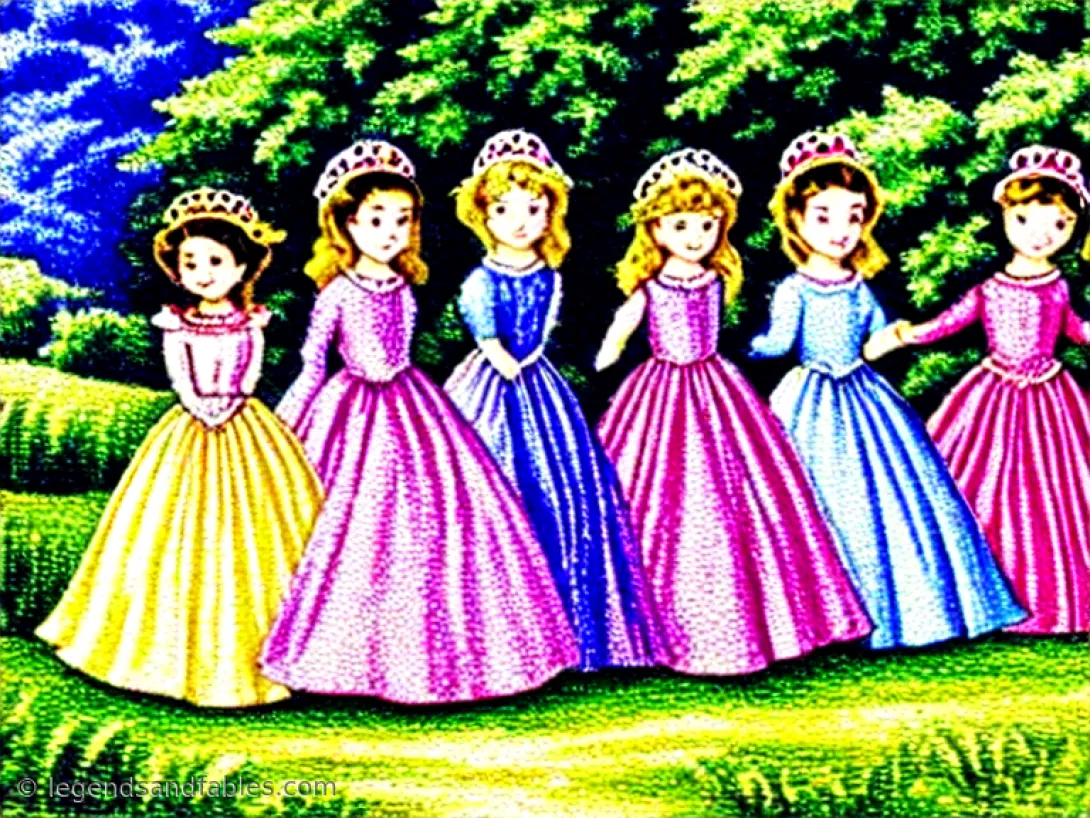
In a small village nestled in the rolling hills of Bavaria, lived the twelve daughters of wealthy merchant, Herr Müller. Their names were: Barbara, Katharina, Margarete, Elisabeth, Anna, Regina, Sophie, Frieda, Charlotte, Gabrielle, Helga, and Ursula. The girls loved to dance, but their father had forbidden them from attending any balls or parties for fear of scandal.
The princesses would often sneak out at night, donning their dancing shoes, and make their way to the nearby forest where they'd dance under the moonlight. But Herr Müller was wise and had noticed that his daughters' shoes were always worn out in the morning, despite having been newly polished the day before. He couldn't understand why this kept happening.
One evening, as he watched from afar, Herr Müller saw the girls slipping out of the house. He decided to investigate further, and soon found himself at the doorstep of the castle where the dancers were said to gather. Inside, he discovered a group of handsome princes, all dressed in their finest attire, waiting for the princesses. Herr Müller was amazed – who were these young men, and why did they seem so taken by his daughters? He struck up a conversation with the leader of the group, a charming prince named Johann.
As it turned out, the princes had fallen deeply in love with the Müller girls and wanted to make them their wives. But Herr Müller was hesitant, worried about his daughters' reputation. The princes convinced him that they would take good care of the princesses and treat them with kindness and respect. In the end, Herr Müller agreed, and the twelve dancing princesses were married off to the handsome princes.
From that day on, the village was filled with laughter and music, as the prince-princess couples danced together under the stars. And every night, when the moon shone bright, the princesses would slip out of their castle windows and dance with their beloved husbands in the forest below. Herr Müller smiled knowingly, proud to see his daughters happy, and grateful for the wise and kind princes who had brought them joy.
The villagers soon learned that the key to happiness lay not in restrictive rules, but in love, understanding, and the freedom to follow one's heart. And so, the story of the twelve dancing princesses was passed down through generations as a reminder of the importance of acceptance and the magic that happens when people come together with open hearts.
💡 Life's Lesson from this story
"Honesty and hard work can bring great rewards, but dishonesty brings only trouble."
🗺️ Cultural Context
📚 Word of the Story
- Finesse — delicacy and subtlety of performance or skill
- Enchantment — a spell that is cast on someone or something
- Gallantry — polite and courteous behavior, especially towards women
💬 Let's Talk About It
What qualities do you think make the king's advisor so clever in figuring out how the princesses are dancing at night?
Would you have had the courage to help the miller's son discover what was happening, even if it meant facing danger and criticism from others?
How does the loyalty of the sisters to one another contribute to the resolution of the story, and is there anything we can learn about being loyal friends from their behavior?