
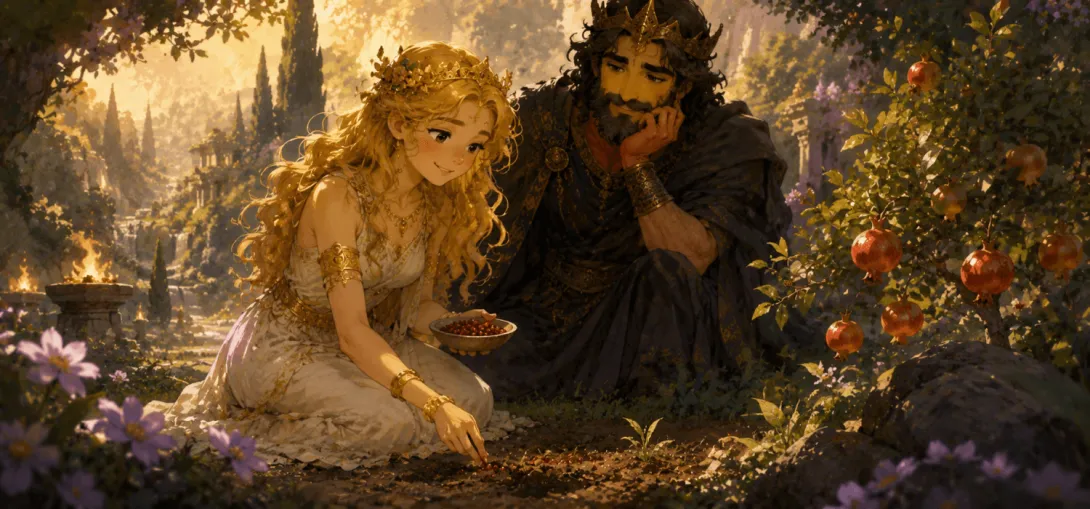
In the lush gardens of Elysium, where sunbeams danced through olive trees and flowers bloomed in vibrant colors, Persephone, daughter of Demeter, goddess of harvest, spent her days playing among the ripening crops. Her laughter echoed through the orchards as she chased after butterflies, her golden hair shining like a ray of sunlight.
Demeter's joy was boundless as she watched her daughter grow and thrive in the idyllic surroundings. She had been entrusted with the care of Persephone by Zeus himself, ensuring that the young girl would inherit the gift of fertility and abundance from her mother.
One day, while exploring the gardens, Persephone stumbled upon a hidden glade where Hades, king of the underworld, resided. His dark realm beckoned to her like an unseen force, and, curiosity getting the better of her, she wandered into its shadows. Unbeknownst to Demeter, Hades had grown enamored with Persephone's radiant presence and decided to take matters into his own hands.
As she explored the underdark, Persephone chanced upon a magnificent pomegranate tree, its branches heavy with juicy red fruits. Hades presented her with six of the luscious seeds, which she, in her innocence, accepted without hesitation. Unbeknownst to her, this simple act sealed her fate.
In the world above, Demeter began to sense that something was amiss. Her carefully tended gardens began to wither and fade, their once-vibrant colors dwindling to dull shades of gray. A dark shadow crept over Elysium as she realized her daughter was missing. She searched far and wide, but every door led only to silence.
In desperation, Demeter descended into the underworld, seeking out Hades, who stood by his pomegranate tree, the symbol of their secret bond. Enraged, Demeter demanded that her daughter be returned to her realm above, where she belonged. Though loath to part with Persephone, Hades knew he had overstepped the boundaries.
A compromise was reached: for each seed Persephone had eaten, she would spend a season in the underworld with Hades, while Demeter's powers of fertility waned during that time. The arrangement allowed Persephone and her mother to share their love across realms. When spring returned, and Persephone rejoined her mother above, Elysium burst forth anew, its gardens blooming more vibrantly than ever before.
As the seasons passed, Demeter's understanding of her daughter's brief absence deepened. She realized that Hades' intentions may not have been malicious but a reflection of his own loneliness in the dark realm. Her compassion and forgiveness allowed Persephone to spend part of each year with him, while she, too, spent time in Elysium, tending the lands her daughter had come to love.
In this way, the pomegranate seeds became a symbol not just of separation but also of love's enduring power. For even as spring and winter danced across the calendar, Persephone remained at the heart of both realms, reminding all who knew her that life, in all its seasons, is precious and worthy of celebration.
💡 Life's Lesson from this story
"Embracing life's cycles and letting go teaches resilience and renewal."
🗺️ Cultural Context
📚 Word of the Story
- Pomegranate — a juicy, sweet fruit with seeds inside
- Persephone — the queen of the underworld in Greek mythology
- Underworld — the place where people go after they die
💬 Let's Talk About It
What does it take for Persephone to be brave and face her fears in the underworld?
How do you think Demeter's love for Persephone affects the story, and what message do you think it conveys about family love?
In what ways can we learn from Persephone's experience with the pomegranate seeds and how they relate to the cycle of life and renewal?