
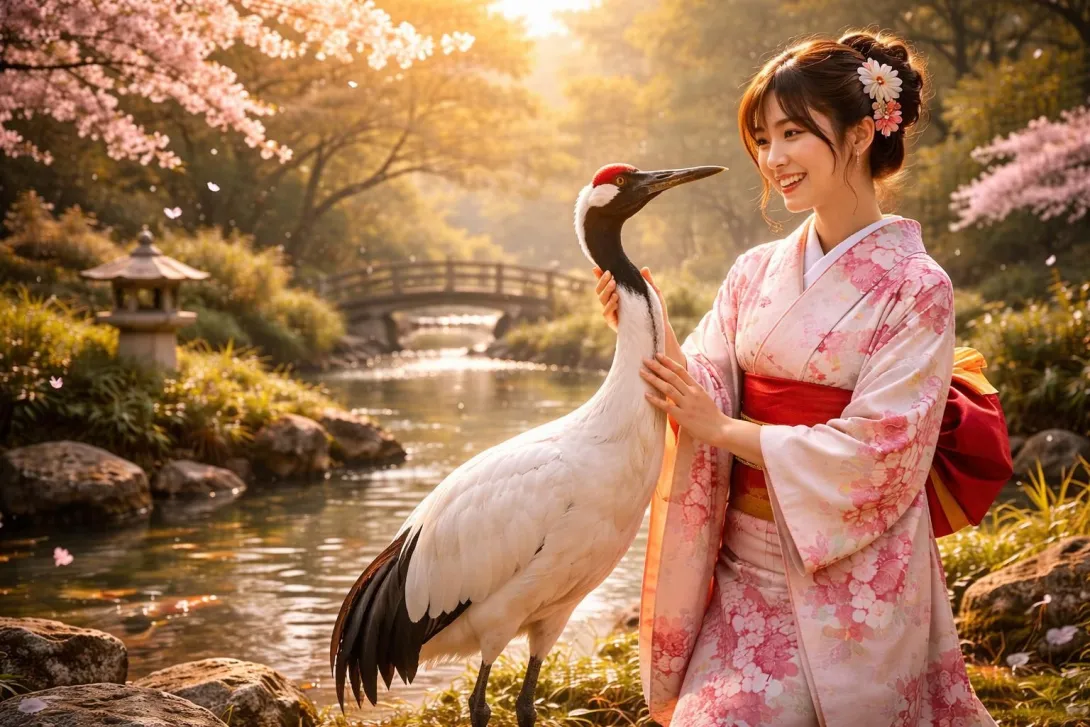
In a tiny village nestled between two great mountains in Japan, there lived a kind and gentle crane named Kaito. His feathers were as white as freshly fallen snow, and his wingspan stretched wide enough to shelter an entire family from the rain. Every morning, Kaito would wade into the tranquil waters of the nearby river, singing sweet melodies that echoed across the valley.
The villagers adored Kaito and often invited him to join in their celebrations. During the Cherry Blossom Festival, he'd dance with the other animals under the blooming sakura trees. His footsteps rustled through the fallen petals like a gentle breeze. The villagers believed Kaito's songs had the power to bring peace and harmony to their community.
One autumn morning, as Kaito prepared for his daily song, he discovered that his beautiful singing voice was fading away. He tried everything – sipping from the purest streams, practicing with his friends, even dancing under the full moon – but no matter what, his songs sounded weak and raspy.
The villagers noticed Kaito's struggles and offered their help. They shared their own secrets for maintaining a strong singing voice: eating sweet potatoes to warm the throat, or listening to the enchanting chirping of the crickets at dusk. Yet none of these remedies restored Kaito's voice to its former glory.
As the days passed, the villagers began to lose hope. Without Kaito's songs, their celebrations felt dull and incomplete. Kaito himself grew despondent, wandering the forest with a heavy heart.
One day, while resting near a serene pond, he met an old wise badger named Hana. She asked Kaito about his troubles and listened attentively as he explained how he'd lost his beautiful singing voice. Hana nodded thoughtfully and said, "Kaito, I sense that your problem is not with your throat or your lungs, but with the harmony within yourself." She took him to a hidden clearing deep in the forest where the ancient trees whispered secrets to each other.
Hana taught Kaito how to listen to their wisdom – the gentle rustling of leaves, the soft creaking of branches, and the quiet hooting of owls at dawn. Under the ancient trees' guidance, Kaito began to reconnect with his own inner harmony. He learned to let go of worries and doubts, embracing the stillness within himself.
As he practiced this newfound balance, his singing voice gradually returned – stronger and sweeter than ever before. The villagers rejoiced when they heard Kaito's melodies once more. They celebrated long into the night under the star-filled sky, dancing and laughing together as one happy family. And Kaito knew that whenever harmony dwelled within him, his songs would echo across the valley like a gentle breeze through the cherry blossoms.
💡 Life's Lesson from this story
Selflessness brings joy, while selfishness only leads to sorrow and emptiness.
🗺️ Cultural Context
📚 Word of the Story
- Festival — a special day or celebration
- Veneration — showing great respect and admiration for someone or something
- Hinduism — a type of religion practiced by people in India
💬 Let's Talk About It
What are some ways Kaito showed kindness to Taro and his family in the story?
How do you think Taro's life would be different if Kaito had not visited him when he was sick?
Can you think of a time when someone was kind or helped you, and how did that make you feel?