
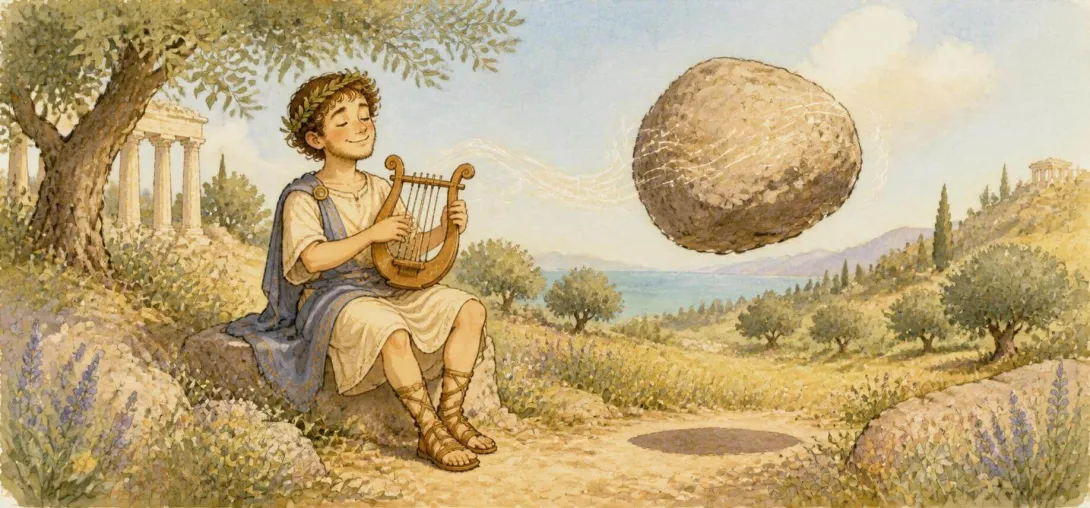
In a small village nestled in the rolling hills of ancient Greece, there lived a young musician named Lykos. His fingers danced across the strings of his lyre with ease and passion, entrancing all who listened. Lykos's music was said to have the power to move mountains, or so they claimed.
Lykos's father, Aristides, was a respected poet, known for weaving enchanting tales that wove together mythology and everyday life. Together, father and son traveled from village to village, sharing their art with anyone who would listen. Theirs was a nomadic existence, but one filled with purpose and joy.
As the years passed, Lykos's fame spread far and wide. People spoke of his music in hushed tones, saying it could calm the savage beasts and bring peace to even the most turbulent of souls. His lyre's enchanting melodies seemed to have a profound effect on all who heard them. When he played near the great river Styx, its waters flowed gently, like a soft lullaby.
One day, Lykos's music caught the attention of none other than Hades, ruler of the underworld. The god was drawn to the village by the haunting beauty of Lykos's melodies, and his interest piqued. He decided to pay Lykos a visit, descending into the world above in search of the young musician.
As Lykos played before the villagers, Hades appeared among them, uninvited but not unwelcome. The god listened intently as Lykos sang of love and loss, of life and death. Entranced by the music, Hades found himself wanting more – he desired to hear the full range of Lykos's talents.
The problem arose when Lykos, unaware of his guest, began to improvise on a sorrowful tune. The notes seemed to cry out in anguish, as if the musician felt the weight of countless sorrows. Hades, moved by the beauty and pathos of the music, requested that Lykos play for him alone.
Lykos, sensing the presence of the god but not recognizing his identity, hesitated at first, unsure whether to obey or flee. But something about Hades's eyes, so deep and sorrowful, put him at ease. He accepted the challenge and began to play with a newfound sense of purpose.
The music poured forth from Lykos like a river overflowing its banks – an unstoppable force that echoed through every corner of existence. Stones quivered beneath their feet as ancient ruins shuddered in time. Even the shadows on the walls seemed to come alive, swaying gently to the rhythm.
And so, with each passing note, Lykos's music bridged two worlds: the mortal realm and Hades' kingdom. As the last chord faded away, the villagers looked upon their world anew – a place where sorrow and joy walked hand in hand, connected by the universal language of music.
Hades, his heart touched by Lykos's art, decided to return him safely to the land above. With this act of kindness, he sealed an unspoken bond between himself and the young musician. From that day forward, whenever Lykos played before the gods or mortals, Hades would listen, enchanted by the beauty of the music that moved stones.
Lykos continued his travels, spreading the message that the power of art lies not in its ability to change fate but in its capacity to bring people – and worlds – together.
💡 Life's Lesson from this story
Love and music have the power to heal even the hardest of hearts.
🗺️ Cultural Context
📚 Word of the Story
- Eurydice — the name of Orpheus's wife who died
- Orpheus — a musician in ancient Greek mythology who was able to play music that could move stones and charm animals
- Lament — a song of sadness and mourning
💬 Let's Talk About It
What does Orpheus's love for Eurydice show us about the power of true love?
Why do you think Orpheus was so brave and willing to journey into the Underworld to rescue his beloved wife?
How can we learn from Orpheus's mistake in the story, when he lets go of Eurydice before reaching the light, and how can we use that wisdom in our own lives?